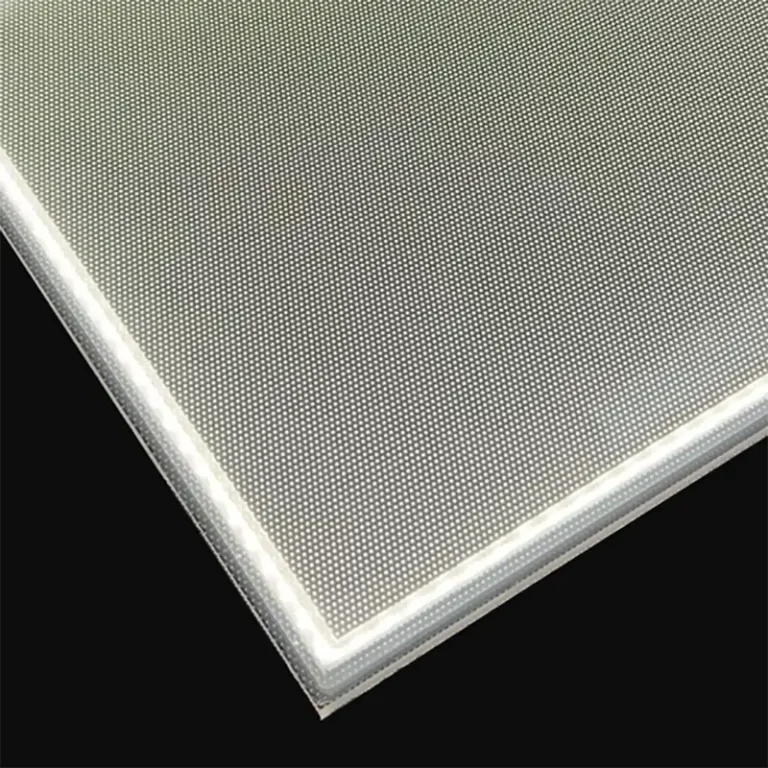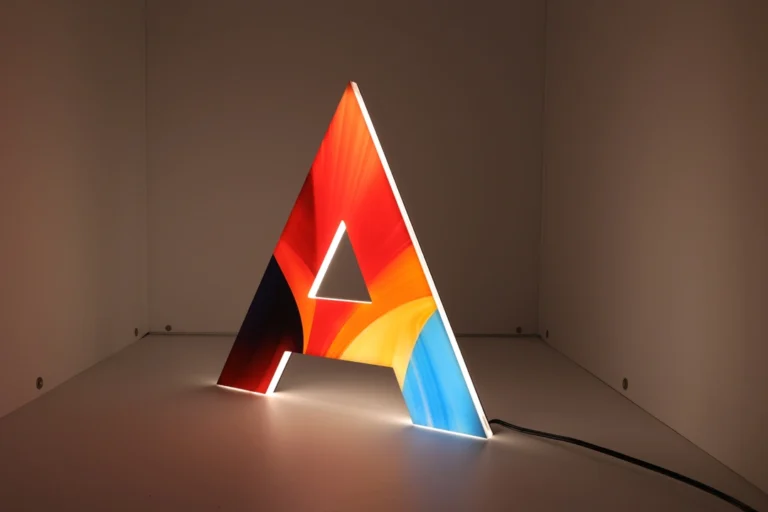
V-Cut and laser-dotted light guide plates are both used to distribute light from edge-mounted LEDs across a flat PMMA surface.
The key difference is not necessarily the processing equipment. Both types can be manufactured using laser processing machines. The main difference is the light-extraction pattern created on the acrylic surface:
A V-Cut light guide plate uses engraved grid lines.
A laser-dotted light guide plate uses a designed dot matrix whose dot size and density are adjusted according to the panel dimensions and LED positions.
Based on our manufacturing experience, laser-dotted light guide plates are generally preferred when a project requires higher brightness, better uniformity, or stronger large-format performance.
V-Cut light guide plates remain suitable for advertising light boxes, illuminated signs, wayfinding signs, linear visual effects, and other applications where standard commercial light performance is sufficient.
Quick Answer
Choose a laser-dotted light guide plate when brightness, uniformity, large-format performance, or precise optical control is important.
Choose a V-Cut light guide plate when the project has standard light-effect requirements, the customer specifically requests a grid-engraved structure, or a processed sheet needs to be divided into several smaller panels.
Both processes:
Can use PMMA acrylic
Can be produced with laser processing equipment
Require no mold
Are suitable for prototypes and small production runs
Support custom shapes and holes
Support single-sided or double-sided illumination
Support single-edge, double-edge, or multi-edge LED input
Their manufacturing costs are generally similar. The selection should therefore be based primarily on the required lighting effect and product structure rather than on cost alone.
What Is a V-Cut Light Guide Plate?
A V-Cut light guide plate is a transparent PMMA plate with a grid of engraved lines on its surface.
When LED light enters the edge of the acrylic plate, it travels through the material. The engraved lines interrupt the internal light path and redirect part of the light out through the emitting surface.
Grooved microstructures can extract light through a combination of reflection and refraction. The geometry, direction, and spacing of the grooves influence the distribution and direction of the emitted light.
In the V-Cut products discussed in this article, the engraved structure is generally arranged as a grid pattern.
Main characteristics of V-Cut light guide plates
- Grid lines are engraved on the PMMA surface.
- No mold is required.
- The grid pattern must be designed before processing.
- The process is suitable for prototypes and small-volume orders.
- A processed large sheet can be cut into smaller panels.
- The cut panels can retain generally uniform illumination for standard applications when the LED and assembly structures remain suitable.
- The engraved lines are visible when viewed closely before assembly.
- The lines may remain visible when the panel is illuminated without a diffuser.
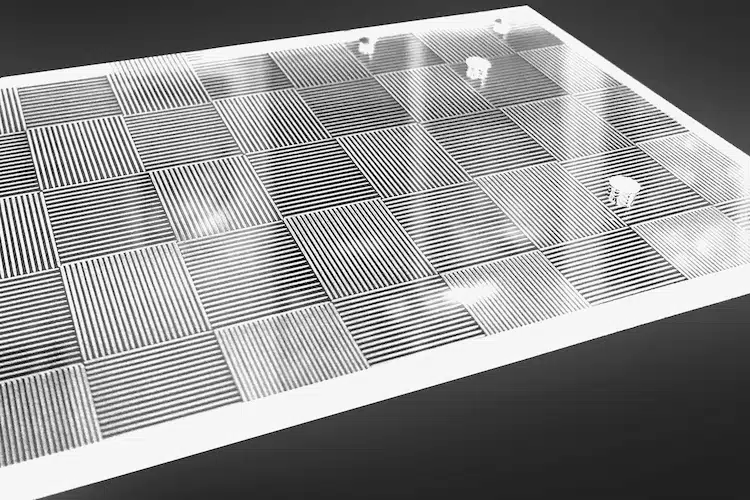
V-Cut is therefore useful when the application does not require highly optimized optical output or when production flexibility is more important than maximum brightness and uniformity.
What Is a Laser-Dotted Light Guide Plate?
A laser-dotted light guide plate uses a matrix of laser-created dots instead of engraved grid lines.
The size, spacing, and density of the dots are adjusted according to factors such as:
- Panel length and width
- Plate thickness
- LED position
- LED spacing
- Number of illuminated edges
- Distance from the light source
- Target brightness
- Required uniformity
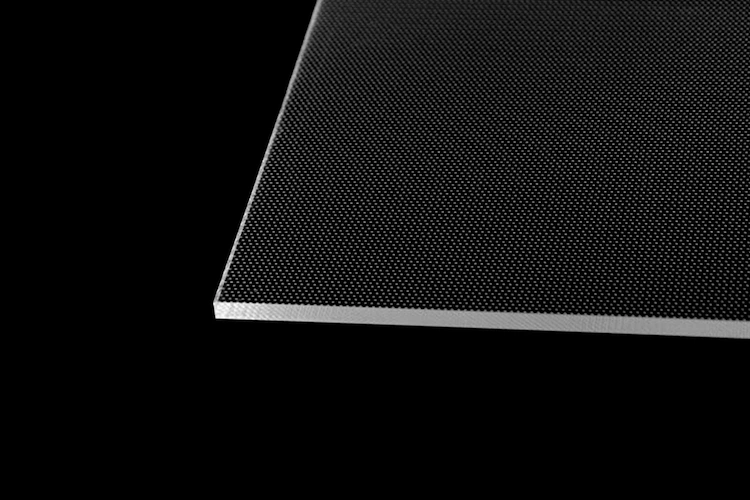
Areas close to the LEDs normally receive more light. Areas farther from the LEDs receive progressively less light as light is extracted along the plate.
The dot pattern therefore cannot simply remain identical across the entire surface. Its distribution must be designed to control how much light is extracted from different areas.
Published optical research confirms that the density, dimensions, distribution, and geometry of light-extraction microstructures affect the brightness and uniformity of a light guide plate. Variable laser-processed scattering dots can be used to control local light extraction more precisely than a single repeated dot structure.
Main characteristics of laser-dotted light guide plates
- A customized dot matrix is produced on the PMMA surface.
- Dot size and density can change across the panel.
- A separate optical pattern must be prepared for each relevant structure.
- No mold is required.
- The method is suitable for prototypes and small-volume production.
- It provides greater flexibility for controlling local light extraction.
- It is generally preferred for projects with higher brightness and uniformity requirements.
- It is more suitable for demanding large-format projects.
The additional work mainly lies in the optical pattern design rather than in a fundamentally different molding or tooling process.
V-Cut vs Laser-Dotted Light Guide Plates
| Comparison factor | V-Cut light guide plate | Laser-dotted light guide plate |
| Light-extraction structure | Engraved grid lines | Designed dot matrix |
| Typical processing equipment | Laser processing machine | Laser processing machine |
| Pattern design | Grid layout | Customized dot size, spacing, and density |
| Mold requirement | No mold required | No mold required |
| Prototype suitability | Suitable | Suitable |
| Small-batch suitability | Suitable | Suitable |
| Optical design complexity | Relatively lower | Higher |
| Uniformity in comparable projects | Standard commercial level | Generally higher |
| Brightness in comparable projects | Generally lower | Generally higher |
| Large-format performance | Suitable when optical requirements are moderate | Preferred when brightness and uniformity requirements are higher |
| Pattern visibility before assembly | Grid lines are visible at close range | Laser dots are visible at close range |
| Pattern visibility without diffusion | Lines are visible | Dots are visible |
| Finished visual appearance | More likely to show processing texture if diffusion is insufficient | Usually less visually obvious with suitable diffusion |
| Cut-to-size flexibility | A processed large sheet can be divided into smaller panels for standard applications | Pattern is normally designed for the intended dimensions and LED arrangement |
| Custom shapes and holes | Supported | Supported |
| Single-sided output | Supported | Supported |
| Double-sided output | Supported | Supported |
| Single-, double-, or multi-edge input | Supported | Supported |
| Relative manufacturing cost | Generally similar | Generally similar |
| Typical selection position | Used when specified or when standard light performance is sufficient | Default priority for projects with higher optical requirements |
The comparison assumes that other factors—such as PMMA quality, LEDs, plate thickness, reflector, diffuser, and mechanical structure—are reasonably comparable.
Changing those factors may change the final result.
Which One Provides Better Uniformity?
In our typical custom projects, a laser-dotted light guide plate generally provides better illumination uniformity than a V-Cut plate.
The main reason is that the laser-dot pattern can be adjusted locally.
For example:
- Dot density may be lower near the LEDs.
- Dot density may increase farther from the LEDs.
- Dot dimensions may change in areas that would otherwise appear dark.
- The pattern may be modified around corners, holes, cut-outs, or irregular edges.
- Different areas can be adjusted for single-edge, double-edge, or multi-edge input.
A V-Cut grid can distribute light across the panel, but it normally provides less precise local control than a customized dot matrix.
This does not mean that every laser-dotted panel will automatically be uniform. The dot pattern must still match the LED position, panel dimensions, plate thickness, diffuser, reflector, and final assembly.
Which One Is Brighter?
Under comparable material, LED, and assembly conditions, our laser-dotted designs generally achieve higher usable surface brightness than V-Cut designs.
This is because the dot distribution can be adjusted to extract light where it is required rather than relying on a relatively regular grid structure.
However, brightness is not determined by the pattern alone.
The final result also depends on:
- LED luminous output
- LED beam angle
- LED spacing
- Number of illuminated edges
- PMMA material quality
- Plate thickness
- Edge polishing and optical coupling
- Reflective film
- Diffuser transmission
- Power and thermal management
- Mechanical assembly
A laser-dotted plate paired with an unsuitable LED or optical structure may perform worse than a properly assembled V-Cut plate.
The complete lighting system must therefore be evaluated rather than comparing only the processed acrylic sheets.
Which One Is Better for Large Light Guide Plates?
For a large-format project with defined brightness and uniformity requirements, we generally prioritize a laser-dotted light guide plate.
As the panel becomes larger, light must travel farther from the LED source. The optical pattern must compensate for the gradual reduction in available light across the plate.
A customized laser-dot pattern provides more control over this process.
V-Cut can still be used for larger panels when:
- The required brightness is moderate.
- Standard commercial uniformity is acceptable.
- The application includes sufficient diffusion.
- The normal viewing distance is relatively long.
- The customer specifically requests a V-Cut structure.
Both V-Cut and laser-dotted plates can be manufactured in sizes up to 2 × 3 meters within our current processing capabilities. The final feasibility must still be evaluated according to plate thickness, LED arrangement, required optical output, structure, and installation conditions.
Are V-Cut Lines Visible?
The engraved grid is visible when a V-Cut plate is viewed closely before illumination.
When the plate is illuminated without diffusion materials, the grid lines are also visible.
After a suitable diffuser is installed and the product is fully assembled, the lines are normally not visible from a normal viewing distance.
For an advertising light box that uses a printed graphic instead of a conventional diffuser, visibility depends on factors including:
- Graphic material
- Graphic thickness
- Printing density
- Ink coverage
- Distance between the graphic and the plate
- Viewing distance
- Required brightness
The graphic material must therefore be evaluated as part of the complete light box structure.
Compared with a laser-dotted plate, V-Cut is generally more likely to show visible processing texture when the diffusion structure is insufficient.
Are Laser Dots Visible?
The dot pattern is visible when the unassembled light guide plate is inspected closely.
The dots are also visible if the plate is illuminated without an appropriate diffuser.
With a suitable diffusion layer and normal product assembly, the dot pattern is generally not visible at a normal viewing distance.
Dot visibility may be affected by:
- Plate thickness
- Dot dimensions
- Dot density
- Diffuser quality
- Diffuser thickness
- Distance between the plate and diffuser
- LED brightness
- Viewing distance
Laser-dotted does not mean that the pattern is invisible under all conditions. It means that the pattern can be designed and integrated into the optical assembly to produce a more controlled finished appearance.
Can a V-Cut Sheet Be Cut into Smaller Panels?
Yes.
A large PMMA sheet can first be processed with a complete V-Cut grid and then divided into several smaller panels.
When the grid pattern, cutting dimensions, LED arrangement, and assembly are suitable, the smaller panels can still achieve generally uniform illumination for applications with standard light-effect requirements.
This provides practical flexibility for projects that require:
- Several panel sizes
- Small production quantities
- Standardized light box components
- On-demand cutting
- Reduced pattern-design work for each individual piece
A laser-dotted pattern is more closely connected to the intended panel dimensions and LED positions. Arbitrarily cutting a completed laser-dot pattern may alter the relationship between the extraction dots and the light source.
For this reason, laser-dotted panels are normally designed around the final dimensions or a clearly defined cutting plan.
Is Laser-Dotted More Expensive Than V-Cut?
The manufacturing cost difference between the two methods is generally not significant in our current production process.
Both can use laser processing equipment, and neither requires a mold.
The design work is different:
- V-Cut requires a suitable grid design.
- Laser-Dotted requires a customized optical dot pattern.
- Laser-Dotted usually involves more detailed adjustment of dot size and density.
- However, the total project cost is influenced by more than pattern design.
- Relevant factors include:
- PMMA size and thickness
- Quantity
- Shape complexity
- Number of holes and cut-outs
- LED configuration
- Reflector and diffuser requirements
- Frame or housing
- Electrical components
- Prototype requirements
- Packaging and transportation
Cost alone is therefore not a strong reason to select V-Cut instead of laser-dotted.
The required lighting result should be established first.
When Should You Choose V-Cut?
A V-Cut light guide plate may be appropriate when:
- The customer specifically requests V-Cut.
- The required light effect is at a standard commercial level.
- The product is an advertising light box.
- The panel is used for an illuminated sign or wayfinding sign.
- The design requires visible linear or grid-based light effects.
- A processed large sheet needs to be divided into several smaller panels.
- The diffuser, printed graphic, and normal viewing distance can sufficiently conceal the line pattern.
- Maximum brightness and highly optimized uniformity are not the primary requirements.
- Typical application directions include:
- Advertising light boxes
- Illuminated signs
- Directional and wayfinding signs
- Graphic displays
- Linear lighting effects
- Pattern-based illuminated structures
- Standard light box components
When Should You Choose Laser-Dotted?
A laser-dotted light guide plate is generally preferred when:
- Higher uniformity is required.
- Higher usable surface brightness is required.
- The panel is large.
- The design is thin and has limited optical mixing distance.
- The product will be viewed at a relatively close distance.
- The project includes irregular shapes, holes, or cut-outs.
- Different areas require different extraction levels.
- The customer expects a more refined finished light effect.
- The LED arrangement requires a customized optical pattern.
Typical application directions include:
- Ultra-thin light boxes
- Retail displays
- Display cabinets
- Product shelves
- Appliance backlighting
- Equipment backlighting
- Custom-shaped illuminated structures
- High-quality signage
- Large-format illuminated panels
- Prototype and small-batch custom projects
Unless a customer has a specific V-Cut requirement or the project only needs standard light performance, we generally evaluate a laser-dotted structure first.
Product and Processing Capabilities
Both V-Cut and laser-dotted light guide plates can be produced within the following general range:
| Item | Available capability |
| Base material | PMMA acrylic |
| Available thicknesses | 2, 3, 4, 5, 6, 8, 10 and 12 mm |
| Maximum processing size | Up to 2 × 3 m |
| Rectangular shapes | Supported |
| Custom shapes | Supported |
| Holes and cut-outs | Supported |
| Single-sided illumination | Supported |
| Double-sided illumination | Supported |
| Single-edge LED input | Supported |
| Double-edge LED input | Supported |
| Multi-edge LED input | Supported |
| Mold required | No |
| Prototype production | Supported |
| Small-volume production | Supported |
These capabilities do not mean that every combination will produce the same optical result.
Large dimensions, unusual shapes, holes, double-sided output, or limited LED positions may require additional optical evaluation and prototype verification.
How We Select the Pattern for a Custom Project
Customers sometimes provide only the external dimensions of the required panel.
Dimensions alone are usually insufficient to finalize a light guide plate pattern.
We first clarify information such as:
- Where will the panel be installed?
- What is the complete product structure?
- Which sides can accommodate LEDs?
- What type of LEDs will be used?
- Is the panel single-sided or double-sided?
- What brightness is required?
- What level of uniformity is expected?
- Will a diffuser or printed graphic be installed?
- What is the normal viewing distance?
- Are there holes, cut-outs, or irregular edges?
- What is the expected production quantity?
- Does the customer specifically require V-Cut?
Based on this information, we evaluate the light-entry method, PMMA thickness, extraction pattern, LED arrangement, and optical layers.
A preliminary structural or solution drawing can then be prepared for further discussion with the customer.
Prototype testing is recommended before mass production, especially for large panels, thin structures, complex shapes, or projects with strict visual requirements.
Selection Summary
| Project requirement | Recommended starting point |
| High uniformity | Laser-Dotted |
| High surface brightness | Laser-Dotted |
| Large panel with defined optical requirements | Laser-Dotted |
| Ultra-thin display structure | Laser-Dotted |
| Retail display or display cabinet | Laser-Dotted |
| Appliance or equipment backlighting | Laser-Dotted |
| Complex shape or locally adjusted light output | Laser-Dotted |
| Standard advertising light box | V-Cut or Laser-Dotted, depending on requirements |
| Illuminated sign with standard light requirements | V-Cut may be sufficient |
| Linear or grid-based visual effect | V-Cut |
| Large processed sheet divided into smaller standard panels | V-Cut |
| Customer specifically specifies V-Cut | V-Cut |
| Cost-sensitive project | Compare the complete structure; process cost is generally similar |
| Insufficient project information | Clarify the structure before selecting either process |
Frequently Asked Questions
Is a V-Cut light guide plate produced with a V-cutting machine?
Not necessarily. In our manufacturing process, both V-Cut and laser-dotted patterns can be produced using laser processing equipment.
The term V-Cut describes the engraved line or groove structure rather than requiring one specific type of machine.
Is laser-dotted the same as laser-engraved?
Laser-engraved is a broader description of laser processing on the plate surface.
Laser-dotted specifically describes a light guide plate that uses a laser-created dot matrix as its light-extraction pattern. In this article, laser-dotted light guide plate is used because it describes the pattern more precisely.
Which method provides better uniformity?
In our comparable custom projects, laser-dotted light guide plates generally provide better uniformity because the dot size and density can be adjusted according to the panel dimensions and LED positions.
The final result still depends on the complete optical assembly.
Which method is brighter?
Laser-dotted plates generally provide higher usable surface brightness in our comparable projects.
However, LED output, edge coupling, plate thickness, reflector, diffuser, and assembly quality also affect brightness.
Which method is cheaper?
The processing cost difference is generally small because both methods can use laser equipment and neither requires a mold.
The complete cost depends more on dimensions, thickness, quantity, optical components, LEDs, structure, and packaging.
Can the engraved lines or dots be seen?
Both patterns are visible at close range before assembly and when illuminated without suitable diffusion.
After installing an appropriate diffuser and completing the product assembly, the pattern is generally not visible at a normal viewing distance.
V-Cut lines are usually more visually noticeable than laser dots when diffusion is insufficient.
Can both types be customized with holes and irregular shapes?
Yes. Both V-Cut and laser-dotted light guide plates can support custom shapes, holes, cut-outs, and different edge-lighting arrangements.
The pattern must be evaluated according to the final geometry.
Can both types provide double-sided illumination?
Yes. Both methods can be used for single-sided or double-sided illumination.
The pattern, LED configuration, diffusion layers, and mechanical structure must be designed for the intended output direction.
Which type should be used for a large light guide plate?
When a large panel has defined brightness and uniformity requirements, laser-dotted is generally the preferred starting point.
V-Cut may still be sufficient when the expected light effect is moderate and the complete product structure provides adequate diffusion.
Conclusion
V-Cut and laser-dotted light guide plates can both be manufactured from PMMA using laser processing equipment, but their optical patterns and intended uses are different.
V-Cut uses an engraved grid structure. It is suitable for standard light boxes, illuminated signs, wayfinding applications, linear effects, and projects that benefit from cutting a processed sheet into smaller panels.
Laser-Dotted uses a customized dot matrix. Its dot dimensions and density can be adjusted according to the panel size and LED position, making it more suitable for projects requiring higher brightness, better uniformity, large dimensions, thin structures, or more precise optical control.
For most projects with defined optical requirements, we evaluate laser-dotted first. V-Cut remains a practical option when the customer specifies it or when standard commercial light performance is sufficient.
Need help selecting a light guide plate pattern?
Send us your panel dimensions, drawing, LED arrangement, installation structure, required brightness, viewing distance, and expected quantity. We will evaluate whether V-Cut or laser-dotted processing is more suitable and provide a proposed structure for further discussion.